The Wisdom of a Crowd of Brains:
A Universal Brain Encoder
Correspondence: roman.beliy@weizmann.ac.il, navve.wasserman@weizmann.ac.il
figures/Figure_Overview_shrank7.PNG
Abstract
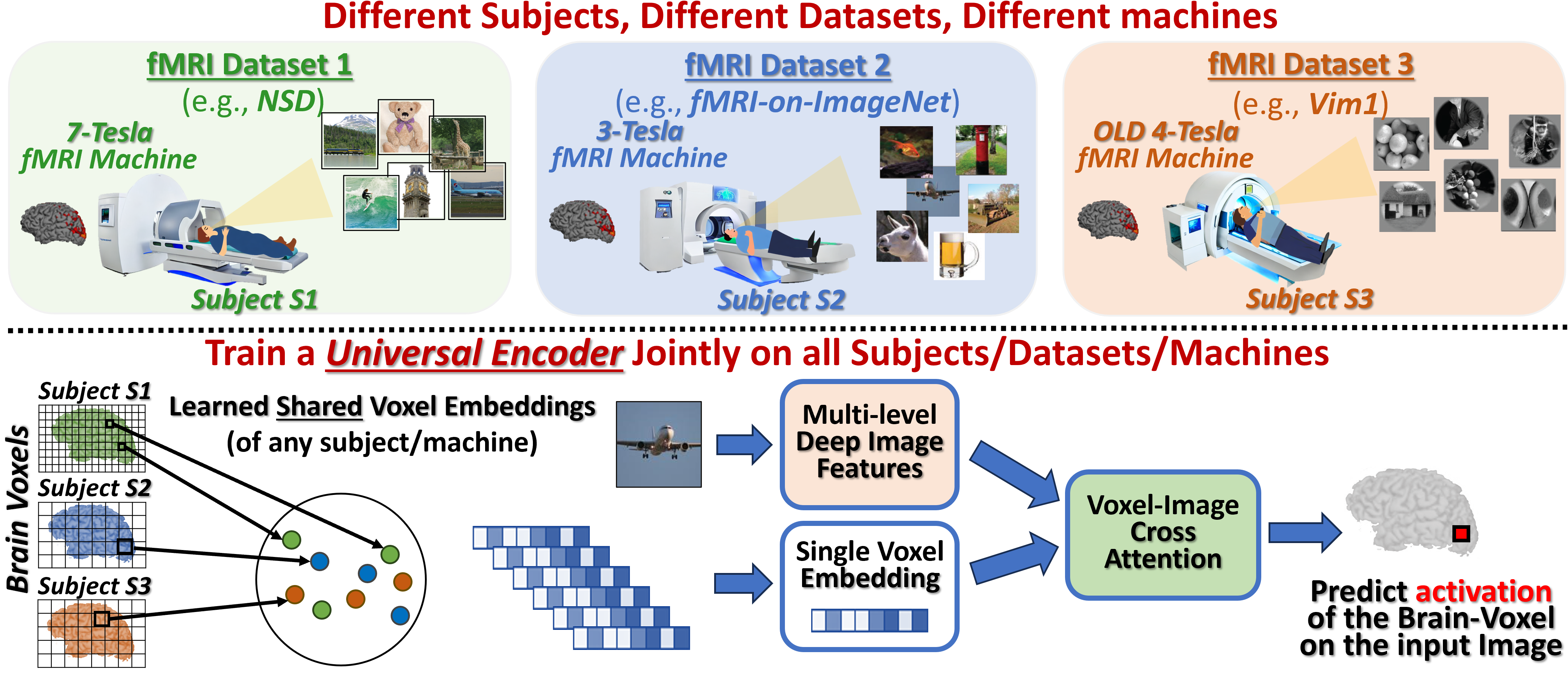
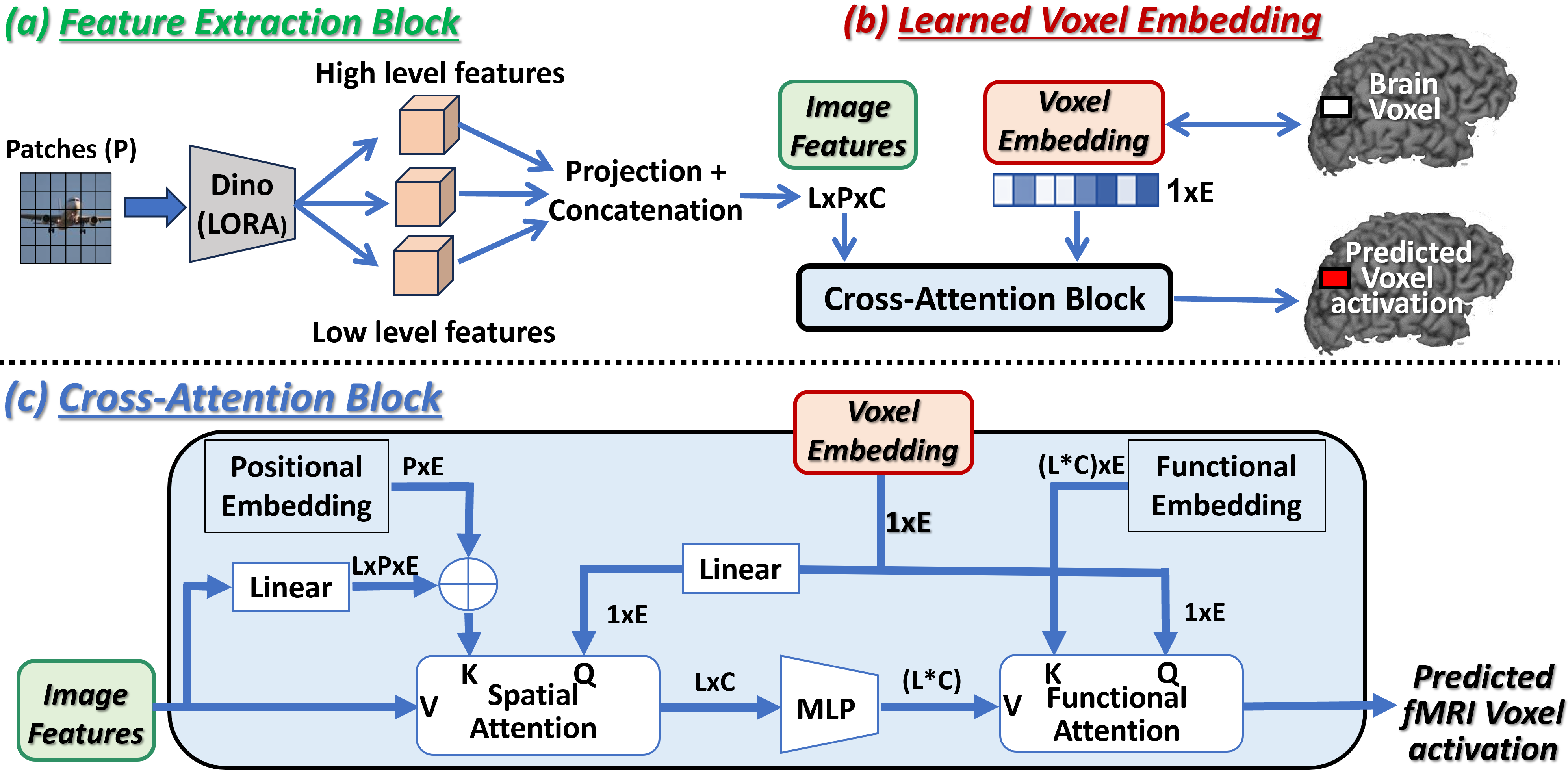
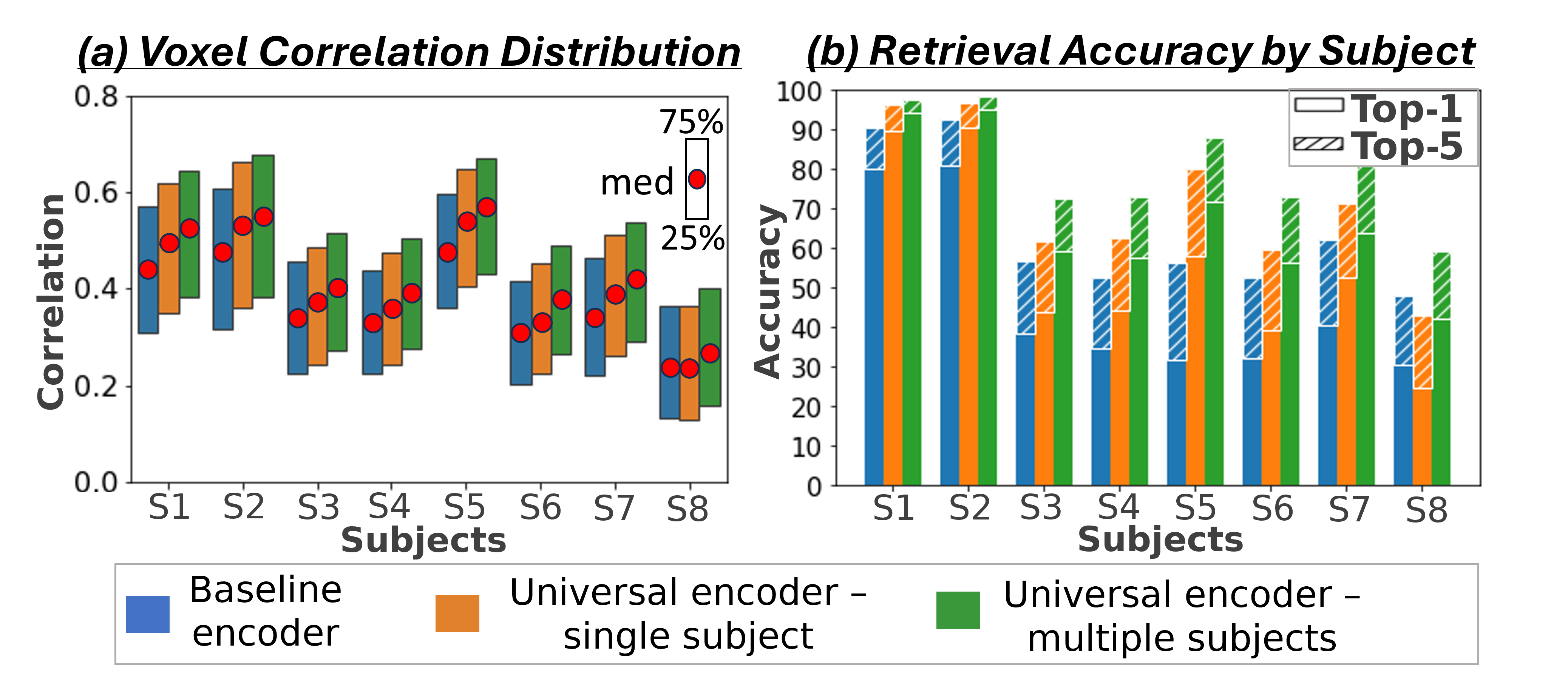
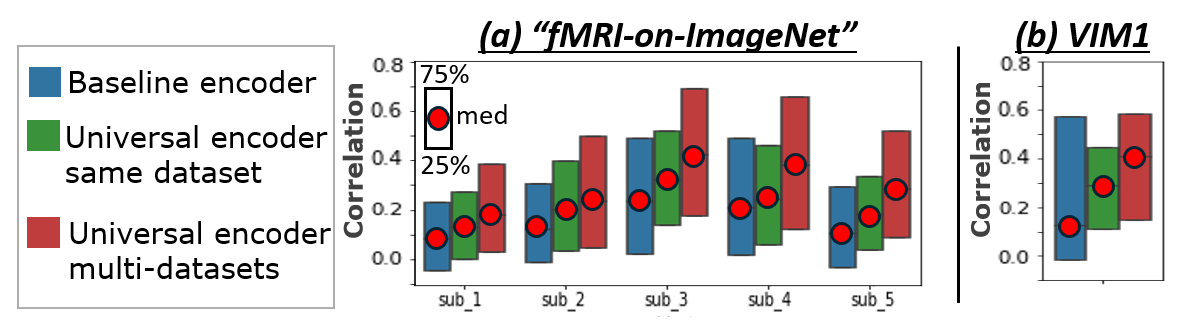
Image-to-fMRI encoding is important for both neuroscience research and practical applications. However, such "Brain-Encoders" have been typically trained per-subject and per fMRI-dataset, thus restricted to very limited training data. In this paper we propose a Universal Brain-Encoder, which can be trained jointly on data from many different subjects/datasets/machines. What makes this possible is our new voxel-centric Encoder architecture, which learns a unique "voxel-embedding" per brain-voxel. Our Encoder trains to predict the response of each brain-voxel on every image, by directly computing the cross-attention between the brain-voxel embedding and multi-level deep image features. This voxel-centric architecture allows the functional role of each brain-voxel to naturally emerge from the voxel-image cross-attention. We show the power of this approach to: (i) combine data from multiple different subjects (a "Crowd of Brains") to improve each individual brain-encoding, (ii) quick & effective Transfer-Learning across subjects, datasets, and machines (e.g., 3-Tesla, 7-Tesla), with few training examples, and (iii) we show the potential power of the learned voxel-embeddings to explore brain functionality (e.g., what is encoded where in the brain).
Universal-Encoder Architecture
figures/UniversalEncoder_shrank9.png
Results
Quantitative Comparison
Setting 1. Encoding accuracy for subjects who completed all recording sessions (NSD dataset).
| Method | S1 | S2 | S5 | S7 | Avg |
|---|---|---|---|---|---|
| Ridge Regression (CLIP) | 0.51 | 0.48 | 0.47 | 0.38 | 0.46 |
| Ridge Regression (DINOv2) | 0.56 | 0.52 | 0.50 | 0.37 | 0.49 |
| Gaziv et al. | 0.50 | 0.52 | 0.48 | 0.42 | 0.48 |
| Adeli et al. | 0.65 | 0.62 | 0.59 | 0.45 | 0.58 |
| Universal Encoder (Ours) | 0.69 | 0.72 | 0.71 | 0.65 | 0.69 |
Setting 2. Following Bao et al. / Chen et al. preprocessing; metrics averaged on subjects 1, 2, 5, 7.
| Method | Pearson ↑ | MSE ↓ |
|---|---|---|
| BrainDIVE | 0.323 | 0.353 |
| fWRF | 0.343 | 0.361 |
| MindSimulator | 0.355 | 0.385 |
| NRF | 0.358 | 0.345 |
| Universal Encoder (Ours) | 0.392 | 0.336 |
Qualitative Evaluation
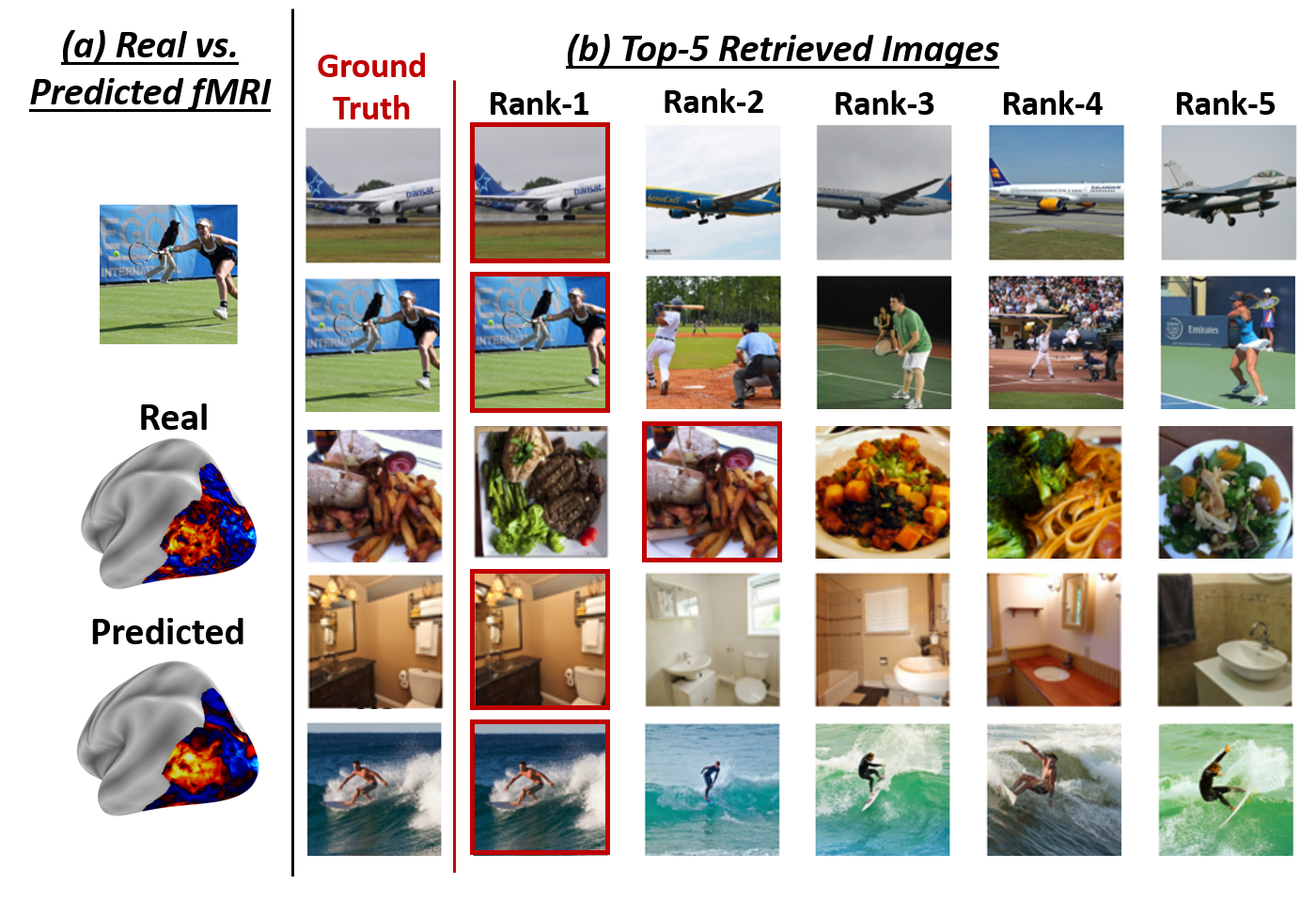
figures/retrieval_brains_1.png
The Wisdom of a Crowd of Brains
figures/wisdom_of_crowds_3.png
The Wisdom of the Crowd of Datasets
figures/Figure_Wisdom_dataset_3.png
Transfer-Learning to New Subjects / Datasets
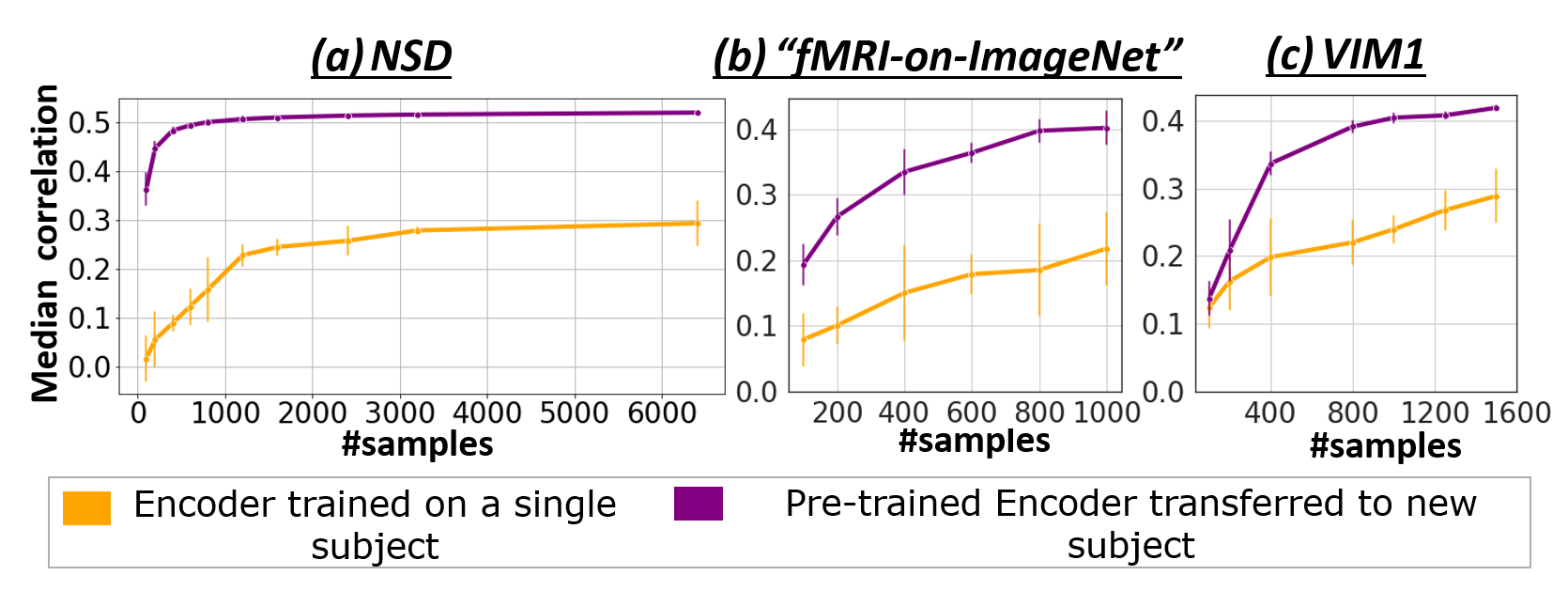
When a new subject or dataset is encountered, the Universal-Encoder does not need to be retrained from scratch. All weights of the pre-trained encoder are frozen, and only the 256-dimensional voxel-embeddings of the new subject are optimized — requiring very little new data. Remarkably, as few as 100 subject-specific examples suffice to outperform a dedicated model trained on the entire training set of 9,000 examples. Transfer also works across scanner resolutions, e.g., from 7T NSD to older 3T and 4T datasets with much smaller training sets and different visual stimuli.
figures/Figure_transfer_3.png
Brain Exploration via Voxel-Embeddings
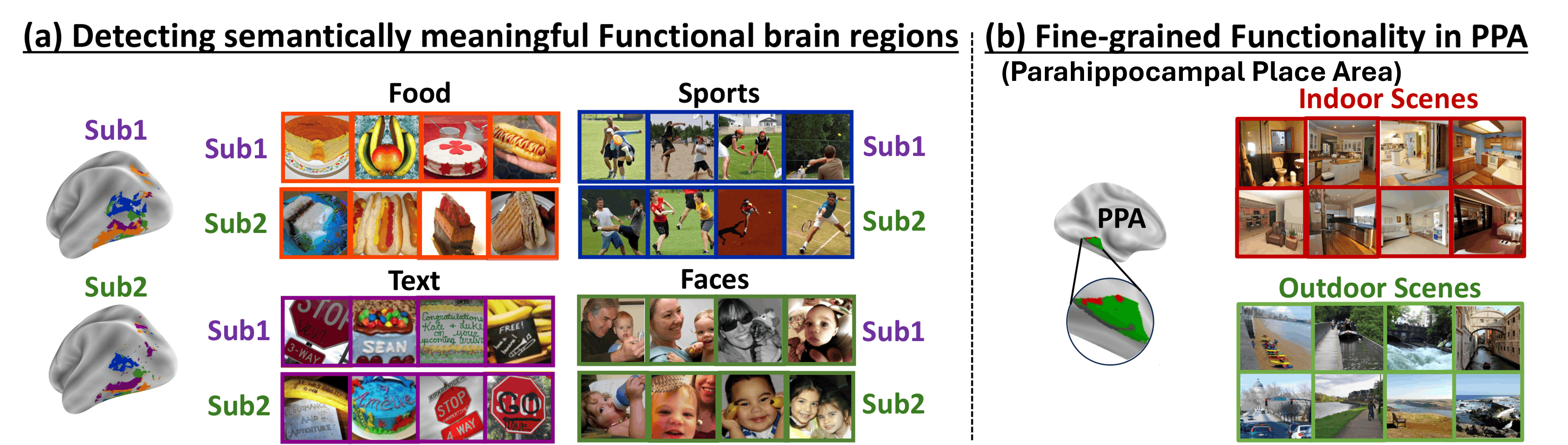
As part of training, the Universal-Encoder maps functionally-similar brain voxels — both within the same brain and across different brains — to nearby voxel-embeddings. Applying k-means clustering to these embeddings reveals shared functional regions across subjects, even though the subjects viewed completely different images and the embeddings were optimized independently. Discovered clusters are activated by semantically coherent categories: Food, Faces, Text, Outdoor Scenes. Notably, these shared functional regions are not anatomically aligned , showing the embeddings capture functional roles rather than anatomical identity. Finer-grained clustering within known regions such as PPA also reveals meaningful sub-regions, e.g., Indoor vs. Outdoor Scenes.
figures/brain_clusters_rebuttal.png
BibTeX
@inproceedings{beliy2026wisdom,
  title     = {The Wisdom of a Crowd of Brains: A Universal Brain Encoder},
  author    = {Beliy, Roman and Wasserman, Navve and Zalcher, Amit and Irani, Michal},
  booktitle = {Proceedings of the 9th Annual Conference on Cognitive Computational Neuroscience},
  year      = {2026},
  doi       = {10.32470/oet3bk8},
  url       = {https://openreview.net/forum?id=ciC5UUZ2Fs}
}